You’re walking through the woods and trip over an old log, scrapping your leg. The bleeding isn’t dangerous, but it definitely needs attention and you don’t have any supplies with you. What would you grab? There are so many herbs for first aid support!
Knowing what foraged first aid herbs you can reach for would be pretty helpful in this situation…don’t you think?
Let’s try another scenario. Your family is out hiking through dense brush and your three year old starts grabbing leaves to make you a bouquet….and it’s all poison ivy. What herbs would you reach for to help limit the reaction she may have?
Wild growing herbs can be found in many regions across the world. It’s important to be familiar with the plant life in your area. This post is based on what is commonly found in most areas of North America. There are many look alikes for some of these herbs, so always ensure proper identification before use and be mindful of sustainable foraging practices.
Let’s get into it.
Wild Yarrow (Achillea millefolium)

- Where to Find: Yarrow thrives in fields, meadows, and forest edges. It is prolific and when left to grow wild spreads quickly and gets significantly bigger year after year.
- How to Identify: Look for its feather-like leaves and smaller clusters of small white flowers.
- Time of Year: Late spring to early fall is when this herb is at its peak, however, the leaves can be used before the plant has flowered.
- Medicinal Uses: The story goes…Roman soldiers used yarrow for wound healing on the battlefield. It’s still known for stopping bleeding and treating deep wounds. It also offers immune support during flu season.
- Properties: Anti-inflammatory, antiviral, diaphoretic, febrifuge, styptic (hemostatic), and vulnerary
- How to Use: Crush the plant material into a poultice or brew the leaves into a tea.
- Tip: Carry a tourniquet and yarrow in your natural first aid kit for emergency situations like deep cuts.
Plantain (Plantago major / Plantago lanceolata)
- Where to Find: Found literally everywhere. Sidewalk cracks, backyards, forest paths, ditches, and meadows. You name it, it grows there.
- How to Identify: Plantain leaves are broad with parallel veins and can be used for bug bites and skin irritations.
- Time of Year: Early spring through fall.
- Medicinal Uses: Known as a common weed, plantain is incredibly versatile. Its leaves can be used to soothe bee stings, poison ivy, and nettle stings.
- Properties: Antiseptic, antivenemous, decongestant, emollient, drawing, and vulnerary
- How to Use: Chew the leaves until they become a paste to create a spit poultice and apply to the affected area, or make a plantain tea for gut and lung support.

Jewelweed (Impatiens capensis)

- Where to Find: Found near water sources, tree branches, and forest edges in mostly sunny areas.
- How to Identify: Jewelweed has orange, tubular flowers that stand out, and the tall stem is shiny and hollow and its leaves create a silvery sheen when submerged in cold water.
- Time of Year: Late spring through early fall.
- Medicinal Uses: This plant is the best wild option for helping with poison ivy and poison oak, dermatological allergic reactions, rashes, and other skin irritations.
- Properties: Anti-inflammatory, anti-histamine, and anti-fungal
- How to Use: Crush the stem and rub the juice directly onto the affected area. The volatile oils released from jewelweed can feel soapy. That’s what you want. Applying a mash from just the flowers will not be effective.
Wild Bergamot (Monarda fistulosa)
- Where to Find: Found in sunny fields and forest edges.
- How to Identify: Tall stems with purple wiry flowers and a mildly minty aroma are tell-tale signs of wild bergamot.
- Time of Year: Mid-summer to early fall.
- Medicinal Uses: Rich in volatile oils, wild bergamot can be used for wound healing, gut support, and immune system support. It’s also helpful for treating insect bites and respiratory conditions.
- Properties: Anti-inflammatory, antimicrobial, anti-emetic, and diaphoretic
- How to Use: Brew the leaves into tea or use them as a spit poultice for external use.

Usnea (Usnea spp.)

- Where to Find: This herb is a lichen that dangles from tree branches in damp, shaded forests.
- How to Identify: Usnea looks like green-gray stringy moss hanging from trees.
- Time of Year: Usnea is available year-round, especially in damp areas.
- Medicinal Uses: Usnea has natural antibiotic properties, is ideal for promoting healing in infected wounds, and is a good option for gastrointestinal infections, and urinary tract infections.
- Properties: Antibacterial, antibiotic, and antifungal
- How to Use: Make a tincture or apply as a poultice to an affected area.
Pine (Pinus spp.)
- Where to Find: Pine trees are abundant throughout North America.
- How to Identify: Recognizable by their long, needle-like leaves and pine cones.
- Time of Year: Year-round availability for needles and resin. Resin is best collected in spring.
- Medicinal Uses: Pine resin is excellent for sealing minor cuts and disinfecting mild to moderate wounds. Pine needles are also very high in vitamin C, helping during flu season. Its best use is for expelling mucus and fighting infection.
- Properties: Antiseptic, drawing, and expectorant
- How to Use: Apply the resin directly to wounds, or steep the needles in boiled water for 10 minutes for a health boosting tea.

Mullein (Verbascum thapsus)

- Where to Find: Mullein grows along forest edges and in fields.
- How to Identify: First-year mullein leaves are soft and fuzzy and grow in a rosette shape, low to the ground. Second-year mullein grows a tall stalk with yellow flowers and soft, fuzzy leaves.
- Time of Year: Late spring to early fall.
- Medicinal Uses: Mullein is one of the best herbs for helping the respiratory system strengthen and tone. It can also be used for wound healing when used topically.
- Properties: Demulcent, expectorant, and lung tonic
- How to Use: Use fresh leaves and brew them into a tea and drink it warm. Breathe in the steam of the tea while drinking it to maximize mullein’s benefits.
St. John’s Wort (Hypericum perforatum)
- Where to Find: Grows in fields, along forest edges, and in forests with dappled light.
- How to Identify: St. John’s Wort has bright yellow flowers with tiny black dots on the petals.
- Time of Year: Early summer
- Medicinal Uses: St. John’s Wort is helpful for nerve pain, skin irritations, and wound healing.
- Properties: Antidepressant, antiseptic, antiviral, digestive tonic, nervine, and vulnerary
- How to Use: This is more of a harvest it and preserve it kind of herb but it’s a big one so it has to be mentioned. Harvest the flowers of St. John’s Wort and infuse the fresh flowers into olive oil. Let it infuse for 4 weeks in a cool dark place. When it’s done it’ll be a deep red color. This makes an excellent muscle and nerve oil for topical use.

Goldenrod (Solidago canadensis)
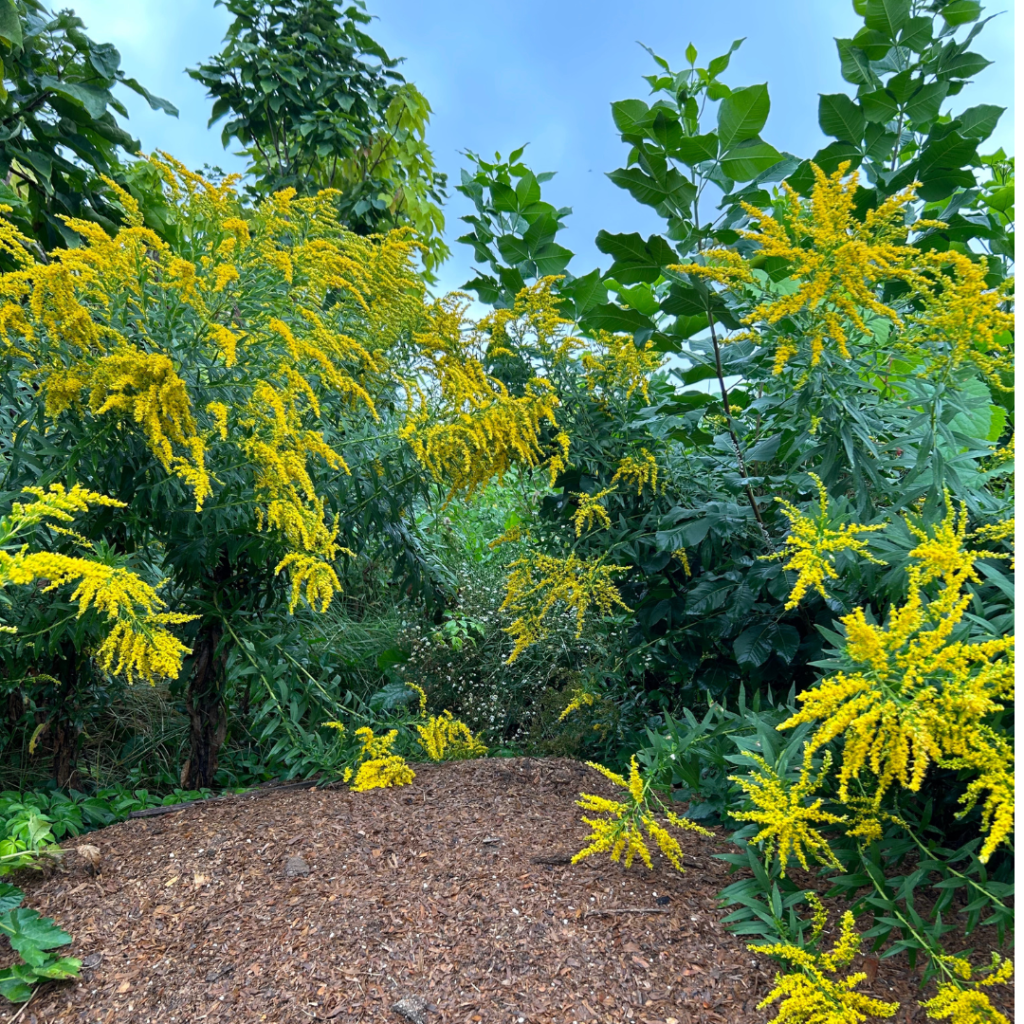
- Where to Find: Prolifically grows in fields, meadows, and forest edges.
- How to Identify: Tall stalks with bright yellow flowers in clusters.
- Time of Year: Late summer to fall.
- Medicinal Uses: Goldenrod is helpful for seasonal allergies and makes a good muscle rub.
- Properties: Anti-inflammatory, antiseptic, and diuretic.
- How to Use: Brew the flowers and leaves into a tea for internal use and a poultice for topical use.
When you’re foraging, you should always consult a field guide to ensure proper identification. In fact, double positive identification is preferred. My go-to reliable sources are Peterson Field Guides specific to your area, and the PictureThis app downloaded to your phone.
These are some of the most common wild herbs located in North America, but there are many more depending on your area. Be sure to familiarize yourself with the plant life before you venture out, and prepare yourself so you know how to use the foraged first aid herbs you find.
Happy Foraging!
If you want to learn more about herbal first aid, check out my Herbal Workshop Series.
